Subscribe to our newsletter for the latest news and updates
SEO in the AI Era: AI Overviews, AI Mode, and GEO
Understand AI Overviews, AI Mode, and GEO. Improve technical foundations and content evidence, then measure search visibility and business outcomes.
SEO in the AI Era: AI Overviews, AI Mode, and GEO
Content reviewed: November 1, 2026.
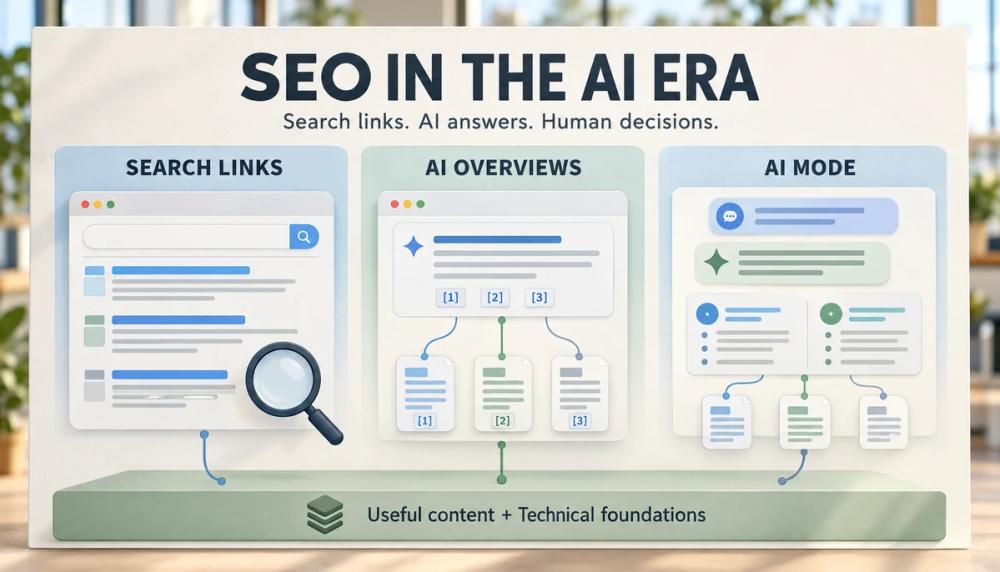
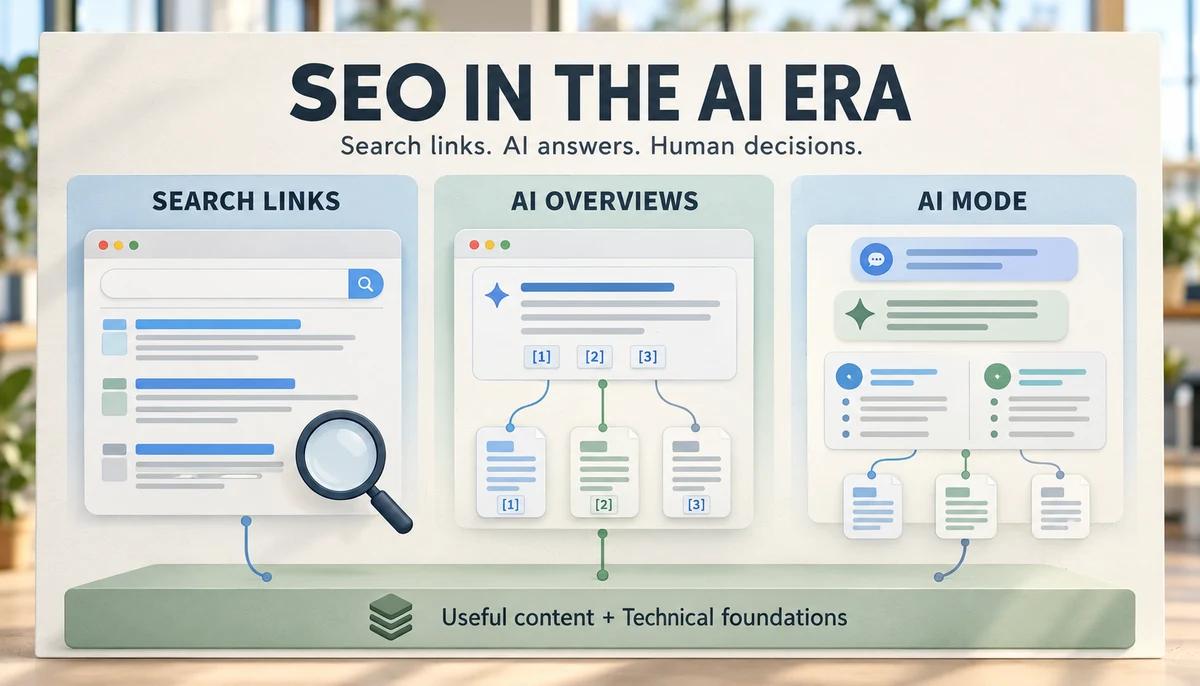
Search results can include traditional website links, AI-generated summaries, and conversational exploration. These experiences coexist. A useful strategy considers how people discover a page, whether they visit it, and what happens after they arrive.
Generative Engine Optimization (GEO) is commonly used to describe efforts to improve visibility in AI-generated answers. It is a marketing term, not a universal technical certification or a guarantee that a particular system will cite your business.
Use current names and specific claims
For Google, distinguish AI Overviews from AI Mode. Google describes the former as summaries for suitable queries and the latter as an experience for more exploratory questions. They can return different answers and links. See Google's explanation of its AI features.
SGE refers to an earlier experimental search experience. Using that label for all current AI search features makes it harder for readers to identify the product or documentation being discussed. Likewise, a recommendation about Google should not automatically be presented as a verified rule for every AI assistant.
Keep the technical foundations
Google's guidance says pages must be indexed and eligible for a snippet to appear as supporting links in its AI features. It does not require special AI schema or files, and inclusion is not guaranteed. Official eligibility guidance.
Translate that into a practical audit of your site. Confirm that important pages are reachable through internal links, render their useful content clearly, and use the intended canonical URL. Investigate unexpected indexing restrictions, broken links, and stale sitemap entries before buying an optimization add-on.
When you change a page, inspect the actual public result. Check its title, description, body, images, and links. A correct CMS entry is only one part of a successful update if the site still serves a cached or incomplete version.
Improve the evidence behind each answer
Choose a question your organization can answer well. State the answer, explain its limits, and show enough evidence for a reader to evaluate it. For a product comparison, distinguish documented features from your own testing. For an implementation guide, provide a worked example and the conditions under which it applies.
Treat experience claims as factual statements. If you did not run a test, do not write “we tested.” If a traffic increase came from a customer case study, link the study and explain its context rather than treating the number as a universal outcome.
Google's people-first content guidance encourages original value, clear sourcing, and accurate information. Author details, source links, and a documented review process help readers judge the work; presenting an “E-E-A-T score” as proof of a result does not.
Make information easier to use
Organize pages around real reader decisions. Use headings that explain what a section answers, concise definitions where a term is introduced, and tables where readers need to compare the same attributes.
For example, a tool comparison should use consistent fields such as intended user, required integration, billing basis, and verified limitations. A collection of unrelated product descriptions forces the reader to perform the comparison again.
Keep important explanations in the article itself rather than only inside an illustration. Use images to clarify a process and provide descriptions that match their subject. Remove repeated introductions and generic filler instead of stretching the page toward a target word count.
Use AI to assist the editorial process
AI can propose an outline, summarize approved source material, or flag inconsistencies between a title and a comparison table. Ask it to identify missing evidence as well as suggest wording.
Editors still need to verify the claims. Google's generative content guidance explicitly includes metadata and image descriptions in the accuracy review. An attractive summary should not hide an obsolete plan name, a fabricated example, or a price copied from an old article.
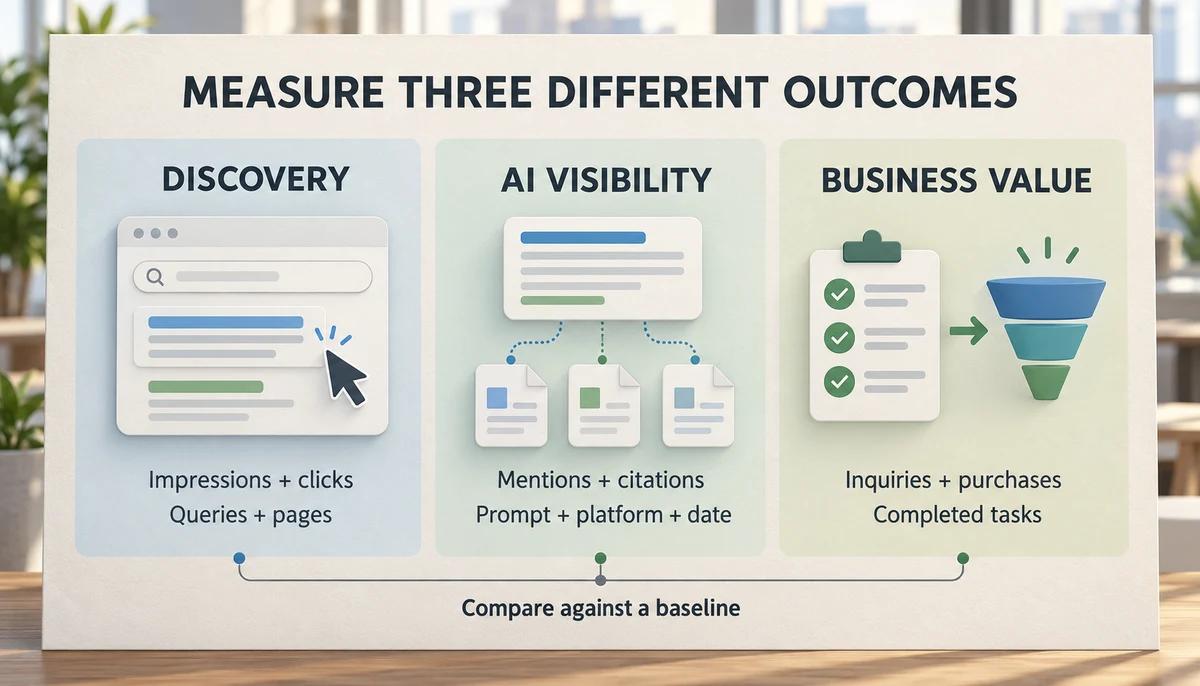
Page-level impressions, clicks, queries, and dates
Whether people can find the page and choose to visit
AI answer visibility
Prompt, platform, date, saved answer, brand mention, and cited URL
What appeared in the observed sample, rather than a universal position
Business value
Relevant inquiries, purchases, or completed tasks
Whether the visits support the page's purpose
Use Search Console for Google's search performance data. If you test AI answers separately, keep the prompt set and observation method consistent enough to compare. A citation without a visit and a visit without a conversion are distinct events.
Avoid attributing every change to AI. Seasonality, new competitors, product launches, site migrations, and other edits can change results at the same time. Keep a change log and compare against an appropriate baseline before claiming an effect.
Build an update process that lasts
Assign an owner to pages that discuss changing products. Review them after meaningful product changes and at a cadence suited to the topic. Check headings, metadata, URLs, price tables, sources, and illustrations together.
Use a visible review date when you have actually checked the content. A year-free URL can remain stable across genuine updates, while the page explains when its information was last reviewed.
GEOly helps readers discover SEO and GEO tools through its directory. Use it to find candidates for research, editing, or measurement, and consult the vendor's current documentation before adopting one. Start with the weakest part of your workflow and judge improvement by the work completed and the outcomes measured.