

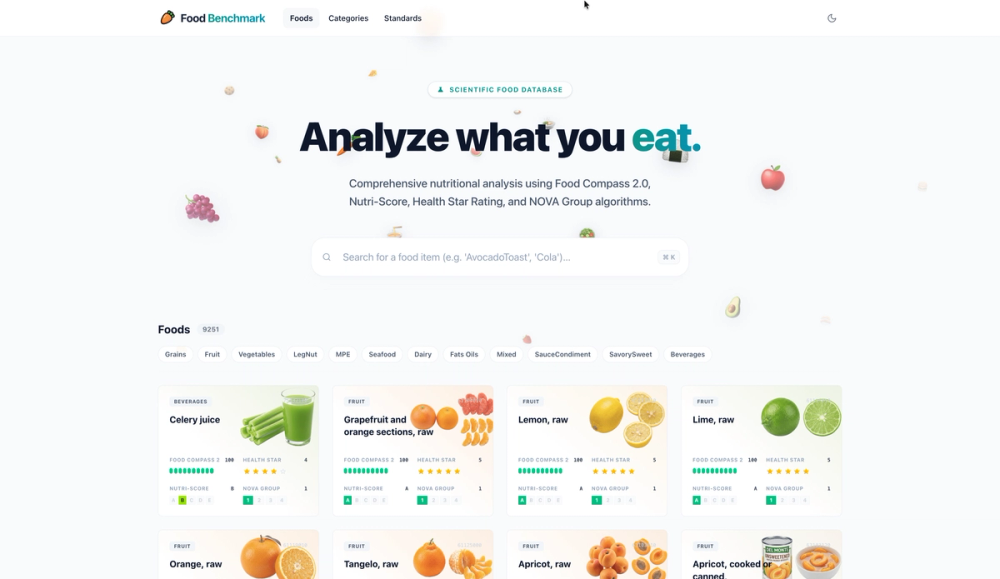
About Food Benchmark Explore thousands of foods and millions of products through a unified data layer powered by Tufts Food Compass, Open Food Facts, USDA FoodData Central, as well as widely adopted classification and labeling systems such as Nutri-Score, Health Star Rating, and NOVA classification. By integrating these heterogeneous data sources, Food Benchmark provides a structured and normalized view of food composition, processing levels, and nutritional quality, enabling users to move beyond fragmented datasets and toward a more systematic understanding of food products.
Features At its core, Food Benchmark aggregates large-scale food datasets into a single, queryable environment. Users can explore granular nutritional information, ingredient compositions, and processing classifications across thousands of food categories and millions of individual products. The platform emphasizes consistency and comparability, allowing users to align different scoring systems and evaluate foods from multiple perspectives—nutritional density, processing level, and overall health impact. Advanced filtering, structured tagging, and standardized data schemas make it easier to navigate complex datasets without requiring extensive manual reconciliation.
Use Cases For individuals and small teams
Individuals, researchers, and small teams can leverage Food Benchmark to reduce the overhead of sourcing and cleaning food-related data. Instead of manually aggregating datasets, users can directly access harmonized information and focus on analysis, experimentation, or content creation. The platform’s intuitive interface and clear data structure reduce ambiguity, making it suitable for rapid exploration, hypothesis testing, or building lightweight applications.
For professionals and larger teams
For enterprises, research institutions, and product teams, Food Benchmark functions as a reliable data backbone. It supports scalable workflows such as nutritional analysis pipelines, product benchmarking, regulatory research, and decision support systems. Its standardized structure enables easier integration into existing tools and data pipelines, while its breadth of coverage ensures that teams can operate with a comprehensive dataset rather than fragmented inputs.
Benefits Clear outcomes By presenting structured, comparable data across multiple scoring systems, Food Benchmark reduces uncertainty and enables users to reach conclusions with greater confidence.
Time savings Pre-integrated datasets and standardized formats eliminate repetitive data preparation work, allowing users to allocate more time to analysis and strategy.
Better decisions Access to multi-dimensional food data—covering nutrition, processing, and scoring—supports more informed and evidence-based decision-making.
Ease of use Despite its depth, the platform is designed to be accessible. Both technical and non-technical users can quickly navigate and extract value, while advanced users can leverage its structure for deeper analytical tasks.
Conclusion In summary, Food Benchmark is a practical and scalable solution for navigating the increasingly complex landscape of food data. By combining authoritative data sources, standardized classification systems, and a user-friendly interface, it enables users to work more efficiently and make better-informed decisions. Whether you are an individual exploring food data for the first time or a professional team building data-driven systems, Food Benchmark provides the infrastructure needed to support your goals.
The platform is continuously updated to reflect new data sources, evolving standards, and user needs. As a result, it remains a reliable and forward-looking tool that can adapt to both simple and advanced use cases. For many users, integrating Food Benchmark into their workflow quickly becomes not just convenient, but essential.


