
Mastering GEO: Best Practices & Strategies for AI-Driven Search Visibility (2026)
Stop chasing blue links and start feeding the models. By 2026, Generative Engine Optimization (GEO) isn't just a niche tactic; it’s the price of admission for staying visible. You need to move beyond simple keyword stuffing and focus on how LLMs actually perceive your brand's authority.
To win in this landscape, you must prioritize authoritative citations and directness. AI search engines favor content that gets to the point immediately and provides verifiable data points. If a bot can’t find the answer to a query in your first two sentences, it’ll likely skip over you for a competitor who is more concise.
Key Strategies for 2026:
- Use Structured Data: Give AI a roadmap with advanced Schema markup so it doesn't have to guess your context.
- Optimize for Sentiment: Ensure your brand is mentioned positively across high-authority platforms to build "model trust."
- Answer Complex Queries: Focus on long-tail, conversational questions that traditional SEO often ignores.
Staying ahead means treating GEO as a dynamic experiment. The algorithms powering these engines change weekly, so your strategy should involve constant testing with specialized GEO tools to see what actually moves the needle. (Trust me, what worked last month is probably already outdated.)
Introduction: Navigating the New Era of AI Search
Google isn’t just a list of blue links anymore. AI Overviews and conversational LLMs have flipped the script on how your audience actually finds answers. If you’ve been chasing traditional rankings, you’ve likely noticed the ground shifting beneath your feet. Welcome to the era of Generative Engine Optimization (GEO), a necessary evolution for anyone looking to stay visible as search becomes a dialogue rather than a simple query.
This shift represents a fundamental paradigm change, not just a minor algorithm update. To keep your traffic growing through 2026, you need to master how GEO differs from the SEO rules you already know. Below, we’ll define the core pillars of GEO, unveil the strategies that actually move the needle, and guide you through the emerging tool ecosystem designed specifically for the AI search era.
What is Generative Engine Optimization (GEO) and How Does It Differ from SEO?
If SEO was about teaching Google how to read your page, GEO is about teaching AI how to summarize it. Generative Engine Optimization is the strategic shift from "linking" to "synthesizing." You're no longer just trying to show up in a list of blue links; you're aiming to be the source material for a direct answer in Google’s AI Overviews, ChatGPT, or Perplexity. While AEO (AI Engine Optimization) paved the way by focusing on voice search and basic intent, GEO targets the complex generative capabilities of LLMs that reconstruct your content into a single, cohesive response.
The transition from SEO to GEO is an evolution of context. In the traditional SEO era, you likely focused on ranking for specific keywords like "best marketing tools." Then came AEO, which emphasized answering conversational questions to capture voice search traffic. Now, GEO requires you to provide factual, semantically rich information that an AI can use to build a custom answer on the fly. It’s the difference between providing a destination (your website) and providing the essential ingredients (your data) for the AI's final output.
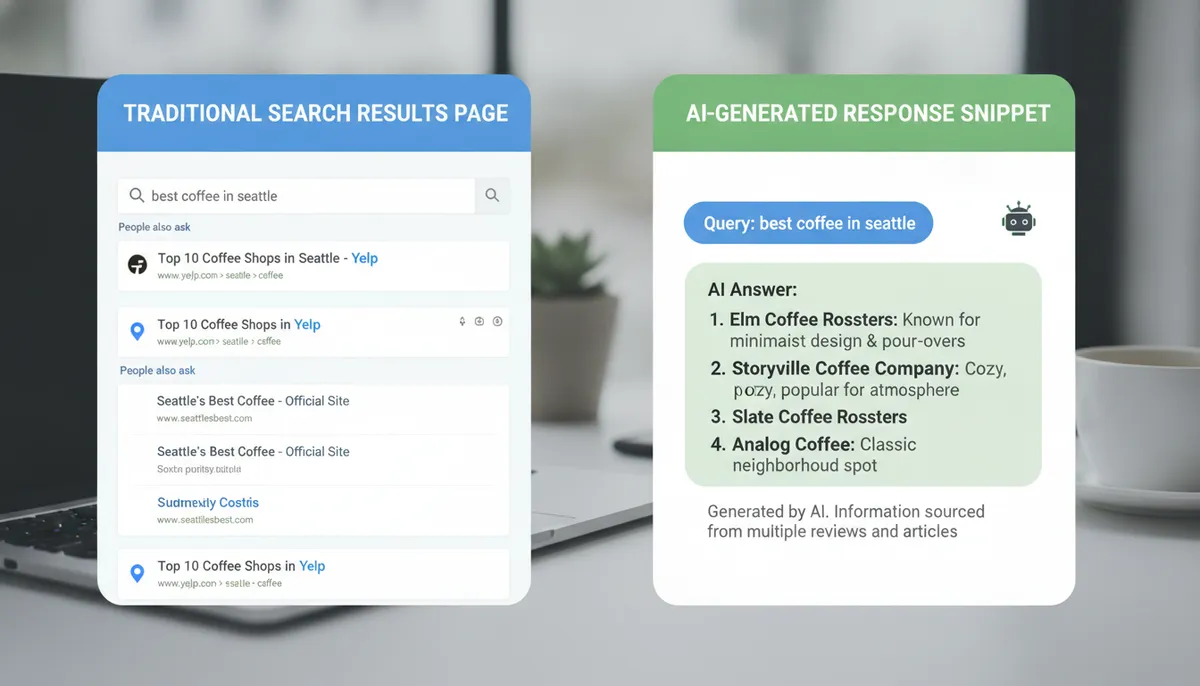
The real distinction lies in how you package your expertise. Traditional SEO favors long-form pages with high-volume keywords, but GEO rewards conciseness, factual density, and "machine-readability." Ranking factors now include how directly you answer a query and your authority within a specific knowledge domain. If your content is buried in fluff, an LLM will simply pass you over for a source that offers a more direct, citable fact or a clearly formatted list.
For you, this means your content’s "job description" has fundamentally changed. You aren't just competing for a click; you're competing for the AI’s trust. Success in this new landscape requires a focus on accuracy and directness that traditional search never strictly demanded. You need to ensure your insights are so clear and authoritative that the generative engine has no choice but to cite you as the definitive source for its users.
Essential Strategies for GEO Success in 2026
GEO success in 2026 isn't about outsmarting an algorithm, it’s about being the most helpful resource in the room. LLMs don't just "index" your pages; they try to understand them. To win, move beyond narrow keyword targeting and focus on semantic depth. Think of an AI like a hyper-intelligent but literal researcher. If you’re writing about GEO tools, don't just repeat the phrase; explain the "why" and "how" behind the technology. Your goal is "answerability." Ask yourself: if a user asks a complex question, can an AI extract a direct, factual answer from your text without getting lost in the fluff?

Google’s "People Also Ask" (PAA) boxes are essentially a cheat sheet for your 2026 content strategy. These queries represent the natural curiosity of your audience. Don't just ignore them; use them as the skeleton for your subheadings. When you address these related questions directly and concisely, you’re basically handing the AI a pre-packaged snippet to use in its overviews. You want your answers to be punchy enough for a quick summary but detailed enough to entice a human to click through for the full story. It’s a delicate balance between being the "quick answer" and the "authoritative guide."
Behind the scenes, your technical setup acts as a translation layer for AI engines. Schema Markup is no longer optional; it’s the handshake between your site and the Knowledge Graph. By using Q&A, HowTo, and Product schemas, you help engines like Perplexity or Gemini identify your brand as a distinct, reliable entity. Consistency is the key here. If your brand is mentioned as a "leading GEO tool" on your site but a "marketing blog" on LinkedIn, the AI gets confused. Ensure your entity recognition, your name, core services, and key concepts, is identical across every digital touchpoint.
As the web becomes saturated with AI-generated noise, your real-world expertise is your most valuable currency. E-E-A-T (Experience, Expertise, Authoritativeness, and Trustworthiness) is the filter that separates human insight from machine-churned "slop." Cite your own data, share "we tried this" stories, and link to reputable sources. If you’ve spent months testing GEOly’s impact on generative answers, lead with those results. LLMs are increasingly trained to prioritize content that shows a "human in the loop", someone who has actually done the work and isn't just summarizing what already exists.
Finally, you can’t optimize what you don't measure. In 2026, "ranking #1" matters less than your "Share of Model." Regularly audit how AI Overviews summarize your brand. Are you being cited as a primary source, or are you an afterthought? Use tools to track which queries trigger your content as a citation and analyze the style of those summaries. If a competitor is consistently winning the "AI Overview" spot, look at their structure. Usually, they’ve provided a clearer factual anchor or a more "summable" list. Watch the data, adapt your formatting, and stay visible as the AI landscape evolves.
Navigating the GEO Tool Landscape: Your 2026 Buyer's Guide
Once you’ve nailed the strategies, you need the right kit to execute them. In 2026, a standard SEO dashboard won't cut it because rank tracking has evolved into AI Overview Tracking. You need a tool that shows you exactly when your content is cited in generative answers and how that attribution looks to a user. If a model summarizes your 3,000-word guide but forgets to link back, you’re effectively working for free. Look for platforms that offer LLM Content Optimization Suggestions, providing semantic tweaks and structural changes that make your data more "digestible" for transformer models.
The battle for visibility now happens inside the "Answer Box," which makes Brand Mention Monitoring your most critical metric. It’s no longer just about social pings; it’s about tracking how often Perplexity or Gemini cites you as a primary authority. A solid tool will provide a deep Competitive Analysis, showing you why a rival is winning the generative response and which PAA (People Also Ask) integrations you're missing. Don't overlook Integration capabilities either; your GEO data needs to flow directly into your existing SEO workflows and platforms like Google Search Console without any friction.
The market has split into two distinct camps for 2026. Established giants like Semrush have pivoted hard, integrating dedicated GEO features like AI Overview tracking and content grading for generative answers. On the other side, specialized newcomers like Peec AI are emerging with a laser focus on AI content optimization and LLM monitoring. Whether you need an enterprise-level suite or a lightweight, niche solution, the choice depends on how much you value granular semantic data. Some users just want to see their AI footprint, while others need to know exactly how their "share of voice" fluctuates across different model updates.
This is exactly where GEOly steps in to save you dozens of hours of trial and error. We built this directory because finding legitimate GEO tools in a sea of legacy software can feel like a full-time job. You can Discover the latest solutions, from comprehensive marketing suites to specialized startups that only handle citation audits. Our platform lets you Compare features, pricing, and real user reviews side-by-side so you aren't guessing which software actually delivers on its promises. It’s the easiest way to bridge the gap between traditional search and the AI-first era without wasting your budget.
Use GEOly to Leverage tools that excel at tracking brand mentions and analyzing LLM-driven traffic. We help you identify the platforms that optimize your content for generative algorithms before your competitors even realize the rules of the game have changed. Our mission is to Empower SEO professionals to stop reacting to AI shifts and start predicting them. You aren't just browsing a list of software; you’re building an arsenal that ensures your content is found, understood, and utilized by the machines. Explore the directory today and find the tool that fits your 2026 growth map.
Conclusion: Your Path to AI Search Dominance with GEOly
The shift from traditional SEO to AI-driven discovery isn't just a trend; it’s our new reality. Dominating Generative Engine Optimization requires a fundamental pivot toward semantic depth, direct answerability, and verifiable authority. If you want your brand to surface when AI models answer user queries, you can't rely on an outdated playbook. It's time to adapt your content strategy to meet these machine-learning demands. By focusing on these pillars, you ensure your visibility stays stable in a post-keyword world. Don’t let the generative revolution leave your site in the shadows. Explore the best GEO tools and strategies on GEOly today to future-proof your digital presence and unlock dominance in the AI search era.