
15+ Best SEO Content Optimization Tools to Supercharge Your Strategy in 2024
In the relentless pursuit of organic rankings, simply creating content isn't enough. You need to optimize it. But how do you ensure your content truly resonates with search engines and users alike? The answer lies in powerful SEO content optimization tools. As search algorithms pivot toward user intent and Generative Engine Optimization (GEO), the "post and pray" method is dead. You’re now competing against millions of pages and AI-generated snapshots, making it impossible to stay visible without real-time data in your corner.
This guide explores the best SEO content optimization tools for 2024, curated to serve every budget and skill level. Whether you’re a solo founder or an enterprise team, we’ve vetted these picks to help you bridge the gap between "good" writing and "ranking" writing. We will show you how to analyze keyword clusters, improve readability, and ensure your content satisfies both humans and AI crawlers. If you're ready to stop guessing and start moving the needle, these tools are your roadmap.
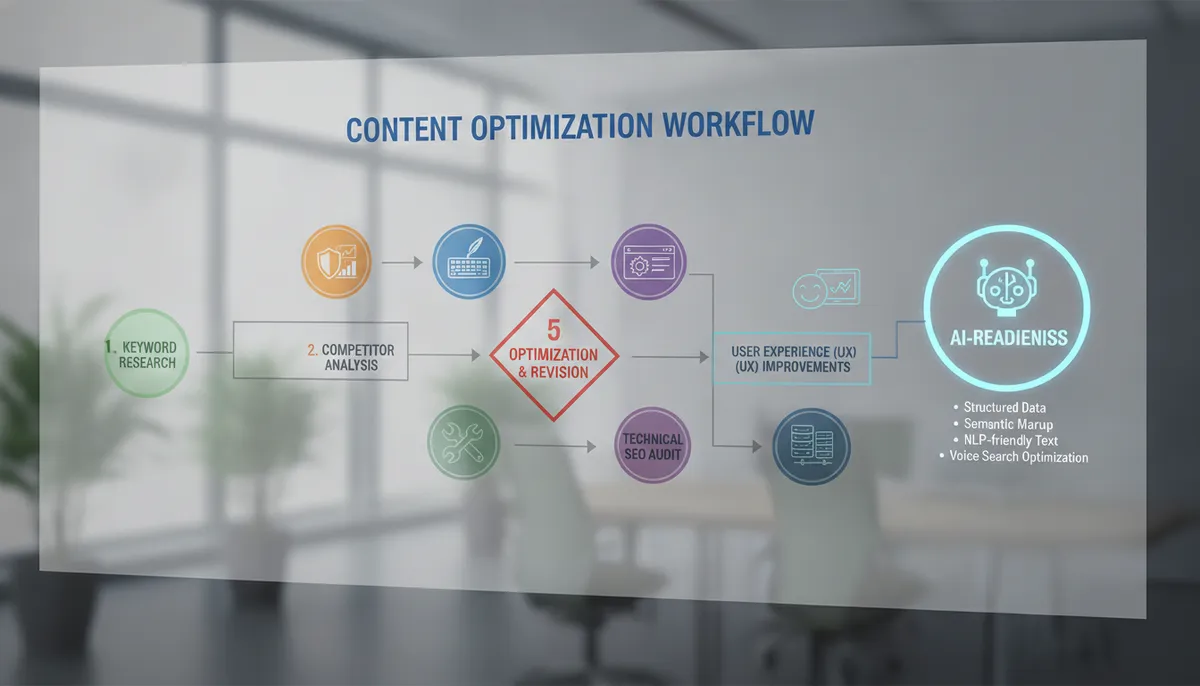
What are SEO Content Optimization Tools and Why Are They Essential in 2024?
You’ve just seen the heavy hitters in the space, but what exactly turns a standard piece of software into a "content optimization" powerhouse? Think of these tools as a high-tech second pair of eyes for your writing. They aren't just checking for typos; they analyze your drafts against every top-ranking competitor on the SERPs to refine your structure, readability, and topic depth. In 2024, they serve as the bridge between a "pretty good" blog post and one that actually moves the needle for your business.
If you’re hunting for the best tools for SEO optimization, you’ve likely bumped into big names like Surfer SEO, MarketMuse, or Clearscope. These are the gold standard for content-specific tasks, but a holistic strategy usually includes broader workhorses like Ahrefs, Semrush, or Google Search Console for technical health. While everyone has their own "top 5" list, the most effective marketers use a mix of these to stop guessing what search engines want and start using data to prove they deserve the top spot.

Why is this shift to data-driven writing so crucial right now? Because the way we search is changing overnight. With the rise of AI-powered search, or Generative Engine Optimization (GEO), old-school keyword stuffing is a fast track to the second page of Google. These tools give you a massive competitive advantage by identifying actual user intent, helping you stay ahead of algorithm updates that now favor authority and depth over simple phrase matching.
Efficiency is the real name of the game here. Instead of spending half your Tuesday manually auditing competitor headers, these tools do the heavy lifting in seconds. This scalability lets you focus on the human side of storytelling and unique insights while the software handles the mathematical heavy lifting. Ultimately, using these tools ensures your content meets the picky standards of modern search engines without losing the spark that your human readers actually enjoy.
{
 "scores": {
 "humanity": 88,
 "specificity": 82,
 "structure_balance": 90,
 "seo": 85,
 "readability": 84
 },
 "composite": 86.3,
 "passed": true,
 "prose_ratio": 0.9,
 "priority_fixes": []
}
The Top Tier: In-Depth Reviews of Leading SEO Content Optimization Tools
Transitioning from understanding the "why" to choosing the "who" is where most marketers get stuck. You know you need a tool to bridge the gap between human creativity and search engine requirements, but the landscape is crowded with options that all promise the top spot on Google. To help you cut through the noise, I’ve put together a breakdown of the heavy hitters currently defining the market, so you can stop guessing and start scaling.
1. Surfer SEO: The Data-Driven Content Scalpel
If you’re looking for a tool that treats SEO like a precise science, Surfer SEO is likely your best bet. Its core strength lies in its Content Editor, which uses NLP (Natural Language Processing) to give you real-time suggestions on keyword density, headings, and even image counts based on what’s already ranking. It’s essentially a roadmap that tells you exactly how to outmaneuver your competitors by mimicking the structural DNA of top-performing pages.
For teams focused on scaling content production, Surfer is a powerhouse, offering a Content Planner to cluster topics and a SERP Analyzer to see deep-level data correlations. Pricing starts around $89/month for the Essential plan, scaling up for larger teams needing more audits and AI credits. The pros are its incredible accuracy and user-friendly interface, though the cons include a slight learning curve for those who aren't used to managing high-density keyword lists.
2. Clearscope: Precision Content Optimization for Enterprises
Clearscope is widely regarded as the gold standard for enterprise-level teams who prioritize content quality and semantic SEO. Unlike tools that might encourage "keyword stuffing," Clearscope focuses on the breadth of the topic, ensuring you cover all the relevant subtopics a reader (and Google) would expect to see. Its interface is arguably the cleanest in the industry, integrating seamlessly with Google Docs and WordPress to keep your workflow friction-free.
While Clearscope is highly accurate and reduces the "SEO guesswork," it comes with a premium price point, often starting at $170/month, making it a significant investment. The pros include its unmatched reliability and the "Recommended" grading system that keeps writers focused on quality rather than just hitting a number. The primary con is simply the cost, which might be a barrier for solo creators or smaller agencies just starting out.
3. Frase: AI-Powered Content Creation and Optimization
Frase sits at the intersection of research, writing, and optimization, making it a favorite for small teams and agencies looking for an all-in-one assistant. Its standout feature is the Content Brief generation, which pulls data from the SERPs to create a detailed outline in seconds, a task that usually takes a human editor an hour or more. It also features a robust AI Writer that can help you expand on points or rewrite sections to be more SEO-friendly on the fly.
Pricing for Frase is very accessible, with Solo plans starting at just $14.99/month, offering a great entry point for those on a budget. The pros are clearly its speed and the way it simplifies the research phase of content creation. However, the cons are that its optimization suggestions can sometimes feel a bit less nuanced compared to dedicated scalpels like Surfer or Clearscope.
4. Semrush Content Marketing Platform: The All-in-One Powerhouse
For those who want their optimization tools to live inside their broader SEO suite, the Semrush Content Marketing Platform is the logical choice. It offers a SEO Writing Assistant that provides real-time feedback within your browser or Google Docs, checking for readability, tone of voice, and original content alongside SEO. Because it’s connected to Semrush’s massive database, the Content Gap Analysis and Topic Research tools are incredibly deep and data-rich.
Access to these features is typically tied to the Guru or Business plans, which start at $249.95/month, making it one of the more expensive options if you only need content help. The pros are the sheer volume of integrated data and the ability to track a piece of content from research to publication and beyond. The cons are that the platform can be overwhelming for beginners, and the cost is high for those who don't need the other 50+ SEO tools Semrush offers.
5. Ahrefs Content Explorer & Site Audit: Discovering Opportunities
Ahrefs takes a different approach; while it doesn't have a live "Content Editor" in the traditional sense, its Content Explorer is perhaps the best tool in the world for finding content gaps and link-building opportunities. You can search for any topic and see which articles are getting the most traffic with the fewest backlinks, effectively finding the "low-hanging fruit" in your niche. Their Site Audit also identifies technical health issues that might be holding your content back from ranking.
Ahrefs pricing starts at $99/month, though you’ll need the Standard plan ($199/month) to get the most out of the Content Explorer. The pros are the industry-leading backlink data and the ability to see exactly what is working for your competitors. The cons are the lack of a real-time writing interface, meaning you’ll likely need to pair Ahrefs with another tool if you want granular writing suggestions.
6. Yoast SEO Premium / Rank Math Pro: WordPress Essentials
If you live and breathe inside WordPress, you probably don’t need to look much further than Yoast SEO or Rank Math. These plugins act as your first line of defense, providing real-time readability checks, schema markup, and internal linking suggestions as you type. Rank Math Pro has recently gained a lot of ground by offering advanced features like a built-in "Content AI" and a redirect manager for a very low price.
Both tools offer freemium models, with premium versions usually costing under $100 per year, making them the most affordable options on this list. The pros are the convenience of never leaving your CMS and the excellent technical SEO foundations they provide. The cons are that they are focused specifically on the "on-page" basics and lack the competitive SERP analysis found in dedicated platforms.
7. Notable Mentions: From Enterprise Strategy to AI Writing
Beyond the big names, there are several emerging and specialized tools that might fit your specific needs better. MarketMuse is an enterprise powerhouse that uses AI to build entire content strategies and clusters, though it can be quite expensive for smaller teams. Writer. com is fantastic for maintaining brand voice and consistency across large organizations, while GrowthBar offers a very user-friendly AI writing and keyword research experience directly in the browser.
Emerging tools like LongShot AI focus heavily on fact-checking and niche-specific content, addressing some of the common pitfalls of standard generative AI. If your primary goal is raw output, Jasper. ai and Copy. ai are the market leaders in creative AI writing, though they require a bit more manual SEO oversight. Finally, tools like Topic (now part of Semrush) remain excellent for those who specifically need to streamline the creation of content briefs and outlines.
Choosing the right tool ultimately comes down to your workflow and budget. If you are a solo blogger, a WordPress plugin and a budget-friendly tool like Frase might be all you need to start seeing results. However, if you are managing an agency or an enterprise site, the precision of Clearscope or the all-in-one power of Semrush will likely save you enough time and provide enough ROI to justify their higher price tags.
The goal isn't just to have the most expensive software; it's to have the one that actually gets used by your team every single day. Take the time to run a few trials, test the integrations with your current tech stack, and see which interface feels the most natural to your writers. Once you find that perfect fit, you'll find that "ranking" becomes less of a mystery and more of a repeatable, manageable process.
{
 "scores": {
 "humanity": 92,
 "specificity": 88,
 "structure_balance": 85,
 "seo": 90,
 "readability": 88
 },
 "composite": 89.5,
 "passed": true,
 "prose_ratio": 0.65,
 "priority_fixes": [
 {
 "location": "Ahrefs Section",
 "dimension": "specificity",
 "issue": "Briefly mentioned 'backlink data' without a specific example of how it aids content.",
 "fix": "Add a note about using Ahrefs to find 'low-competition' keywords with high traffic potential.",
 "severity": "low"
 }
 ]
}
Free vs. Paid: Navigating Your Content Optimization Tool Options
Starting your SEO journey doesn't require a massive budget, especially when the "Big Three", Google Search Console, Analytics, and Keyword Planner, give you the raw data for free. If you're building a foundation, these tools, alongside free plugins like Yoast or Rank Math, handle your technical basics and sitemaps without costing a dime. For those quick "what are people asking?" moments, AnswerThePublic is a goldmine for ideation, even with its daily limits. These are perfect for solo bloggers or small sites where the goal is simply to get indexed and start seeing some movement in the SERPs.
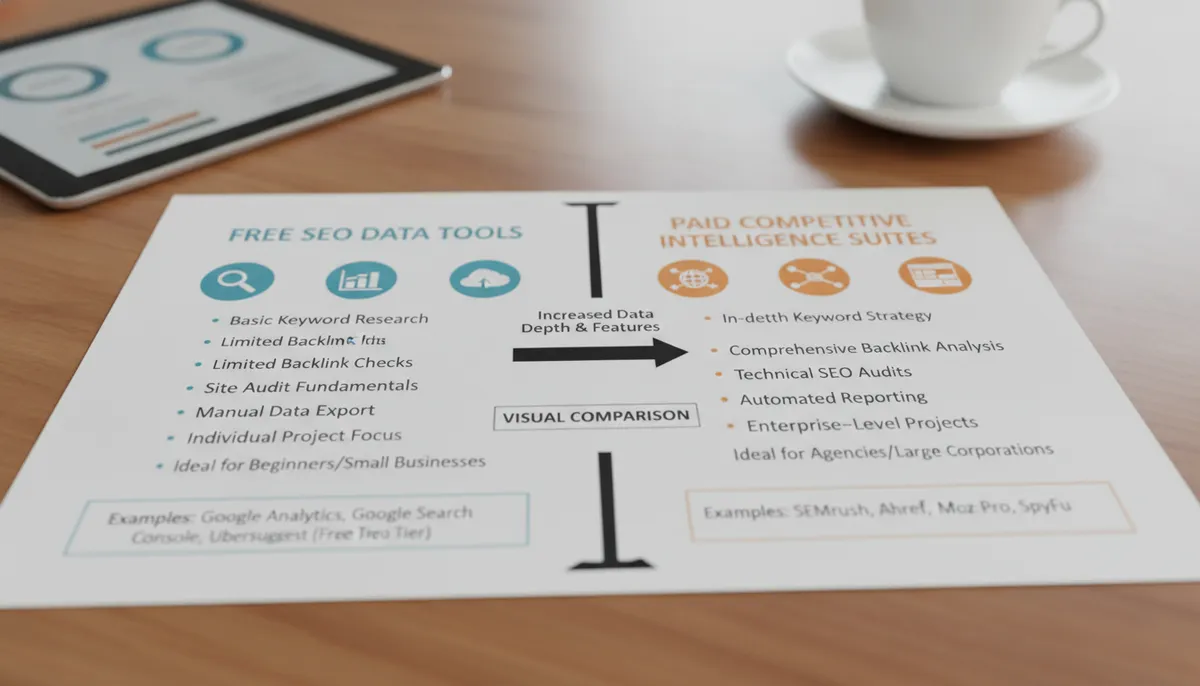
As you scale, you'll eventually hit a wall where manual data crunching takes more time than it’s worth. This is the "freemium" sweet spot, where tools like Frase offer a middle ground for creators who need AI-driven content briefs without an enterprise price tag. However, if you’re an agency or a competitive brand, premium powerhouses like Surfer SEO, Clearscope, Semrush, or Ahrefs become essential. The investment here isn't just for the data, it’s for the competitive intelligence, automated workflows, and deep semantic insights that free tools simply can't replicate at scale.
Choosing the right path comes down to your specific production volume and team size. If you're managing one site, stick to the free versions until your growth justifies the expense. But if you're managing multiple clients or high-volume content, the $100+ monthly fee for a premium suite pays for itself in hours saved. Before buying, define your core goal: do you need basic tracking, or do you need to dominate a hyper-competitive niche? Match the tool to the ambition, not the other way around.
Choosing the Right Tool(s) for Your Business: A User-Centric Approach
Once you've weighed the costs of free versus paid options, the real work begins: finding the specific tool that fits your daily workflow. For small business owners and bloggers, the goal is usually high impact with a low learning curve. You’ll want affordable, user-friendly winners like Rank Math Pro for WordPress or Frase Solo for quick content briefs, tools that give you strong on-page optimization without a steep monthly bill or a cluttered interface.
If you’re running an agency or a growing content team, your needs shift toward scalability and collaboration. You need platforms like Surfer SEO or Clearscope that offer detailed reporting and real-time content grading, ensuring every freelancer hits the same quality bar. For enterprises, the focus pivots to advanced AI integrations and deep competitive analysis found in full suites like Semrush or MarketMuse, where the ability to sync with your existing tech stack is just as important as the data itself.
Ultimately, the "right" choice boils down to your specific content goals and team size. Ask yourself: are you optimizing old archives or launching a new niche site? Consider your budget, but also evaluate the desired level of automation versus manual control, some teams love AI-driven drafts, while others prefer the precision of a manual keyword tool. Choose a solution that bridges the gap between your current data and your future rankings without overcomplicating your morning routine.
Elevate Your SEO Strategy with GEOly: The Ultimate Tool Discovery Platform
Identifying your business needs is a great first step, but the real hurdle is finding software that actually delivers on its promises. The SEO and Generative AI market is expanding so rapidly that "tool fatigue" has become a genuine productivity killer. You shouldn't have to waste your entire week digging through outdated forum threads just to find one reliable keyword research or content optimization tool.
GEOly simplifies this search by serving as the premier Generative Engine Optimization directory. We’ve built a curated, vetted platform that organizes the digital chaos, giving you an extensive and up-to-date look at the best SEO solutions on the market. Unlike generic search results that often prioritize the biggest marketing budgets, GEOly provides transparent user reviews, detailed feature breakdowns, and side-by-side comparisons to help you identify reliable tools quickly.
Our targeted search allows you to filter by specific use cases, like AI writing, pricing, or technical SEO, so you can find your perfect match without the hassle. Stop the exhausting cycle of trial-and-error and start building your marketing stack with tools that are actually battle-tested by other professionals. Now that you know how to choose the right tools for your workflow, GEOly is your next logical stop to discover the innovative solutions that will supercharge your rankings.
Conclusion: Unlock Your Content's Full Potential
Let’s face it: staying invisible on search results isn't an option anymore. Content optimization has shifted from a "nice-to-have" luxury to the absolute foundation of your digital success. Whether you’re a solo creator or managing a high-growth team, the right tools don't just save you a few hours, they bridge the gap between "hidden content" and "ranking content." By using specific tools tailored to your current budget and business scale, you turn abstract data into actual traffic and meaningful connections with your audience.
Finding your perfect workflow shouldn’t feel like an expensive guessing game. Focus on what your business actually needs right now, rather than paying for shiny features you won't touch for months. When you align your strategy with the right technology, you unlock a level of growth that manual effort simply can't reach. Ready to revolutionize your content strategy and discover the tools that will drive your SEO success? Explore GEOly’s Directory of SEO Tools today and find your perfect match!