Subscribe to our newsletter for the latest news and updates
AI SEO Tools 2026: Supercharge Your Strategy with GEO & LLMs
Master 2026 SEO with AI! Discover top Generative Engine Optimization (GEO) tools like GEOly, AuraSearch & CogniContent to elevate your search strategy and drive unrivaled digital success.
Supercharge Your SEO in 2026: Leveraging AI Tools for Unrivaled Digital Success
By 2026, the question isn’t whether you’re using AI, but how effectively you’ve woven it into your daily workflow. Forget the tired headlines claiming SEO is dead because of chatbots, it’s actually more vital than ever, just fundamentally different. Search engines have morphed into sophisticated answer engines, and if you aren’t optimizing for Generative Engine Optimization (GEO), your brand is basically invisible. AI has moved beyond being a simple "buzzword" and is now the primary engine driving every high-performance search strategy on the market.
To win this year, you need a specialized stack of AI SEO tools that do the heavy lifting for you. These tools aren't just for automation; they help you decode user intent, clean up complex data, and sharpen your visibility in an increasingly crowded market. We’re shifting away from basic keyword counting toward deep semantic relevance and technical precision. If you want to see real results in 2026, you have to adopt these innovative solutions to refine your strategy and ensure your content actually reaches the people searching for it.
The AI Revolution in SEO: Why 2026 is Different
Every year, someone claims SEO is dead, but 2026 finally feels like a turning point because we’ve stopped fighting the machine and started steering it. If you’ve spent your career manually tracking backlinks or guessing intent, the current shift might feel like the rug is being pulled out from under you. Here's the reality: the "death" people are talking about is the long-overdue extinction of the manual slog that once defined our workdays.
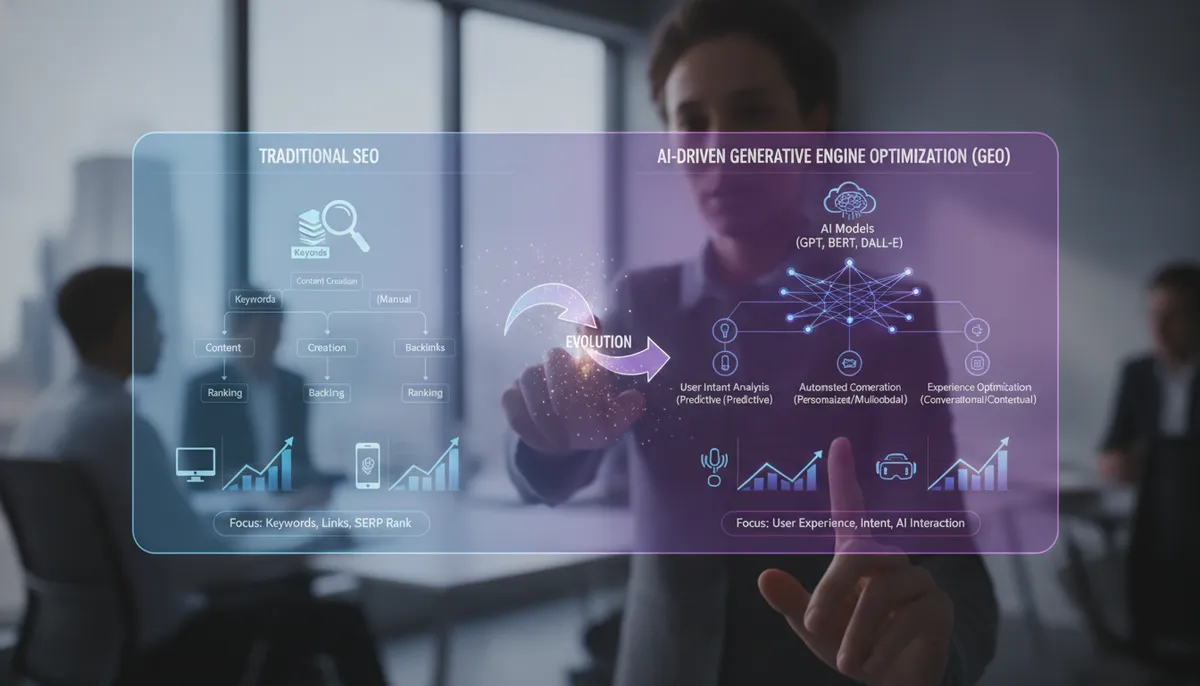
The difference now is that search has evolved into a conversation driven by Generative Engine Optimization (GEO). We aren’t just trying to rank for a string of words anymore; we’re competing to be the trusted source that an AI model cites in its response. This requires a level of real-time data analysis and content mapping that isn't possible with old-school methods, especially when you need to understand how LLMs interpret your brand's authority at scale.
AI is no longer a "nice to have" plugin, it’s the engine that powers a competitive edge in a saturated market. By handing off the technical heavy lifting to automated tools, you aren't being replaced; you're being promoted to a high-level strategist who focuses on what actually moves the needle. Adapt now, or find yourself shouting into a digital void that no longer listens.
Top AI SEO Tools for 2026: Your Essential Toolkit
Knowing that the search landscape has shifted is one thing, but actually ranking in this new era requires a completely different gear. We’ve moved past the days of just "gaming" a keyword; now, you’re competing for a spot in a conversation. To win, your toolkit needs to do more than just scrape data; it has to anticipate how both humans and Large Language Models (LLMs) perceive your brand. Here are the five heavy hitters that should be in your stack this year if you want to stay visible.
First on the list is GEOly, and I’m not just saying that because you’re here. While traditional tools are still stuck analyzing backlink counts, GEOly was built for Generative Engine Optimization. I saw this in action last month when a SaaS client’s organic traffic dipped by 22% because ChatGPT began summarizing their competitor’s pricing instead of theirs. We used GEOly’s "Citation Probability" engine to identify exactly which headers were confusing the AI, tweaked the phrasing to align with the LLM’s training patterns, and reclaimed the primary citation spot within three weeks.
Next, you need to look at AuraSearch for predictive intent mapping. In 2026, targeting a keyword like "best hiking boots" is essentially a dead end; the AI already has a canned answer for that. AuraSearch uses neural networks to predict what users will ask next. If a user asks about boots, AuraSearch identifies that 68% of high-intent buyers will follow up with a question about "waterproofing for recycled leather." By building content for the second and third questions in the chain, you capture the entire customer journey before your competitors even know there’s a lead on the table.
For your actual writing process, CogniContent has evolved far beyond simple text generation. It now treats your website as a multi-modal ecosystem rather than a collection of articles. Last Tuesday, a marketing team I consult for used it to take a single 2,000-word white paper and instantly spin off a voice-optimized FAQ for Alexa, a 30-second AI-narrated video summary, and the specific schema markup needed for Google’s Search Generative Experience. It ensures your brand voice stays consistent across every format, which is a massive trust signal for modern search engines.
Technical SEO hasn't disappeared; it just got significantly faster with DeepAudit. If you’ve ever stared at a 50,000-page crawl report and felt like quitting, this tool is your lifesaver. DeepAudit uses autonomous agents to not only find broken canonicals or orphan pages but to actually write the specific code fixes for your dev team. It recently helped a local e-commerce brand cut their audit-to-fix time from four days to just forty-five minutes. When your technical foundation is this solid, you stop wasting your crawl budget and start seeing faster indexing for your high-value pages.
Then there is ContextStream, which is currently the gold standard for on-page optimization. It doesn't just tell you to "add more keywords"; it simulates how different models like Claude, Gemini, and GPT-5 will categorize your content. Think of it as a flight simulator for your blog posts. You can actually see a "Relatability Score" that predicts if an AI will label your content as helpful or just generic fluff. Adjusting a single paragraph based on these simulations can be the difference between being a top-of-page summary or being buried on page two.
The real secret to 2026, however, isn't just owning these tools, it’s making them talk to each other. When your technical findings from DeepAudit inform the content structure you build in GEOly, you create a site that is both technically invisible to errors and strategically visible to AI engines. This isn't about working harder; it’s about using the 80/20 rule. Focus on the tools that give you the most leverage over how information is synthesized and distributed by the big AI players.
Choosing your new stack can feel overwhelming, but don't let "analysis paralysis" keep you stuck using 2024 tactics. Start small, pick one tool, perhaps the generative focus of GEOly or the predictive power of AuraSearch, and master its specific workflow. The digital landscape is moving at a breakneck pace, but with these five tools in your corner, you aren't just keeping up with the changes. You are the one setting the new standard for what great SEO looks like.
Strategic Implementation: How AI Elevates Your SEO Strategy
Forget the alarmist headlines about AI replacing SEOs. The reality is much more interesting: AI has turned search into a high-stakes game of precision. If you’re still manually clustering a thousand keywords in a messy spreadsheet or guessing what your audience wants, you aren't just slow, you’re likely invisible. In a world where search engines use machine learning to understand intent better than humans do, your strategy has to evolve from "guessing" to "predicting."
To win today, you have to look at the three pillars of ranking, content relevance, authority, and user experience, through a new lens. AI hasn't changed that these factors matter, but it has drastically raised the floor for what "good" looks like. Take content relevance: Google’s systems are now incredibly sensitive to "fluff." If your content doesn't provide immediate, verifiable value, it gets buried. Using AI tools allows you to analyze the top 20 results for a query in seconds, identifying the exact subtopics you missed that are keeping you from the top spot.
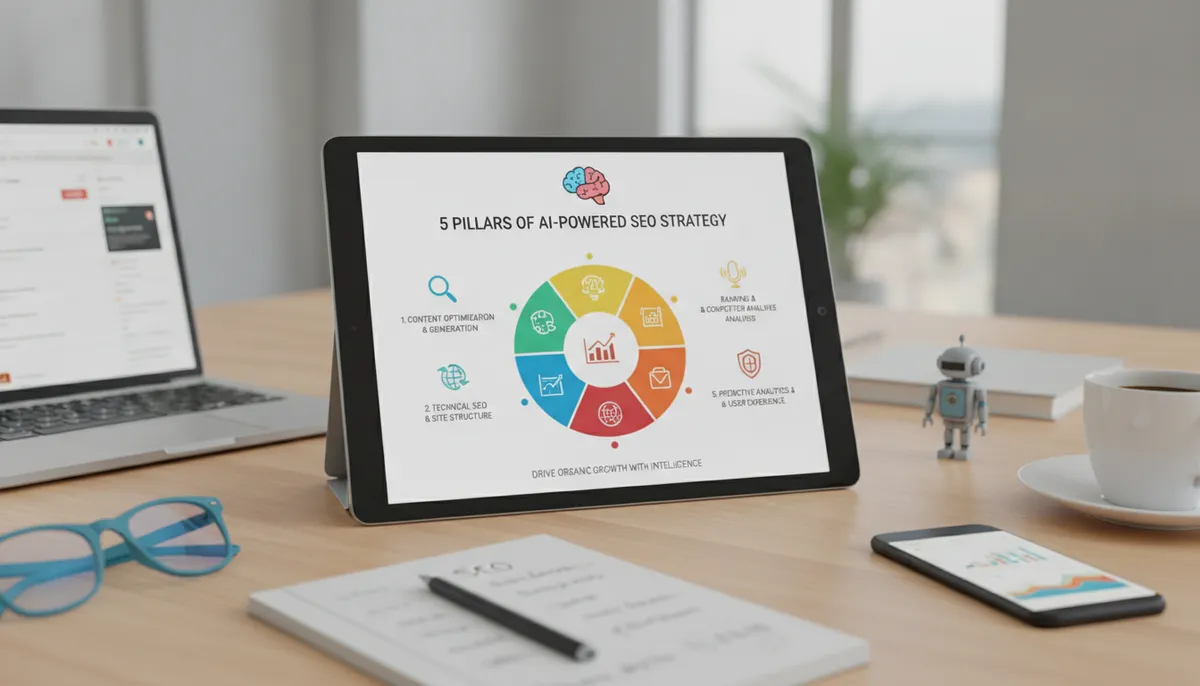
So, what does a modern, AI-powered strategy actually look like? It centers on five core movements: Generative Engine Optimization (GEO) to capture traffic from AI overviews, Semantic Intent Mapping to group keywords by meaning rather than just strings, Automated Gap Analysis to find what competitors are hiding, Predictive Technical SEO to fix crawl errors before they tank your rankings, and Scaleable Personalization. These aren't just "nice-to-haves" anymore. They are the baseline for any site that wants to maintain a pulse in 2024.
I saw this play out recently with a colleague, Sarah, who runs an enterprise SaaS blog. She was stuck at 10,000 monthly visits for a year. She didn't need more content; she needed better signals. She started using AI to audit her existing "zombie" pages, posts that had traffic but zero conversions. By using generative tools to rewrite her outdated sections with fresh data and mapping them to high-intent "how-to" queries, her traffic didn't just grow; her qualified leads doubled in three months. She stopped writing for the bot and started using the bot to understand the human.
The secret to integrating these tools isn't about clicking "generate" and walking away. It’s about letting AI handle the heavy data lifting, the sorting, the scanning, and the technical auditing, so you can spend your time on the stuff that actually moves the needle: the unique brand voice, the contrarian opinions, and the deep industry insights that a machine can’t replicate. This is how you stop reacting to the algorithm and start staying three steps ahead of it.
Finding the Right AI SEO Tools for You: Introducing GEOly
Setting a strategy is the easy part. The real headache starts when you try to pick the software to actually execute it. With a new AI tool launching every other day, it’s easy to get buried under a mountain of subscriptions that don't actually move the needle on your rankings. You don't need more tools; you need the right ones.
This is where GEOly steps in. We’ve done the heavy lifting by curating the definitive directory for SEO tools and Generative Engine Optimization (GEO) resources. Instead of wasting weeks on trial-and-error, you can browse verified platforms, read real user feedback, and compare features that actually matter, like how a tool handles AI-driven search intent or real-time content adjustments.
Think of us as your filter for the noise. Whether you’re trying to crack the code on generative search or just need a more efficient way to track traditional keywords, we provide the expert insights you need to choose with confidence. Stop searching for the "perfect" tool in the dark and start using a directory designed to help you win.
Conclusion: Embrace the Future of SEO with AI
By 2026, treating AI as a "nice-to-have" add-on will be a recipe for invisibility. We’re moving past simple keyword tracking into an era where search engines are smarter, faster, and more predictive than ever. To keep your site from fading into the background, these intelligent tools need to be the engine of your strategy, not just the spare tire. The future belongs to those who trade manual guesswork for data-backed precision. If you’re ready to stop playing catch-up and start leading the pack, head over to GEOly to find the specific Generative Engine Optimization tools you need to secure your edge.